
Choosing the Right Fastener Finish: Zinc Plating vs. Hot-Dip Galvanizing vs. Geomet
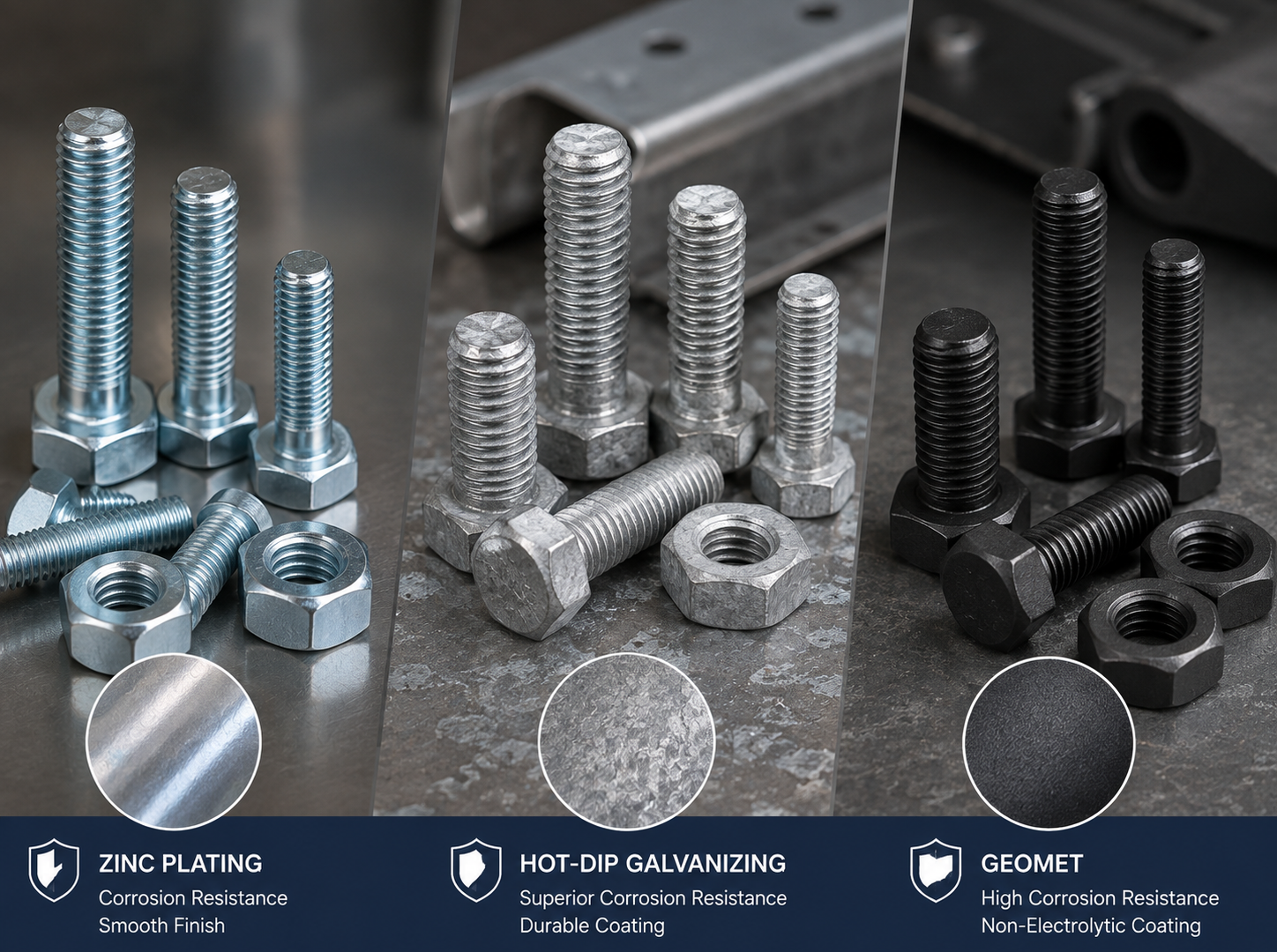
Two fasteners can share the same DIN number, the same grade, and the same steel — and still perform completely differently in the field, because the finish on top of that steel is doing most of the work once the part is actually installed. Finish selection is where a lot of otherwise-correct specifications quietly go wrong, usually because “zinc plated” gets written down as a catch-all when the application actually calls for something else entirely.
Zinc plating (electroplating)
Electro-galvanizing deposits a thin, bright, uniform zinc layer — typically 5 to 25 microns — over the fastener. It’s the standard choice for indoor or mild-exposure applications: general construction hardware, machinery assembly, automotive components not directly exposed to weather. It’s inexpensive, keeps tight tolerances (important for fine threads), and gives a clean appearance. Its corrosion resistance is real but limited; in outdoor, coastal, or high-humidity environments it will start showing red rust within a few years, sometimes sooner.
Hot-dip galvanizing (HDG)
HDG dips the finished fastener in molten zinc, building a much thicker, metallurgically-bonded coating — commonly 45 to 100+ microns. That thickness is what gives HDG its outdoor and structural-grade reputation: it’s the default finish for scaffolding systems, formwork hardware, structural bolts on bridges and highways, and anything that will sit outside for its working life. The trade-off is dimensional: the thicker coating can require oversized nuts or tapped threads to maintain proper fit, which is why HDG fastener sets are usually supplied as matched pairs rather than mixed with plain-finish components.
Geomet and Dacromet (zinc-flake coatings)
These are thin, non-electrolytic zinc-and-aluminium-flake coatings, usually under 10 microns, that deliver corrosion resistance disproportionate to their thickness — often outperforming much thicker zinc plating in salt-spray testing. Because the coating is so thin, it holds dimensional tolerance almost as well as plain steel, which makes it popular in automotive and precision assemblies where both corrosion resistance and tight fit matter. It’s a more specialised, typically costlier option, and is usually specified by exact name (Geomet 500, Dacromet 320, etc.) rather than left generic.
Stainless steel — when plating isn’t the answer
For the most aggressive environments — chemical exposure, marine environments, food-grade or hygienic applications — the better answer is often not a coating at all but a stainless grade (SS304 for general corrosion resistance, SS316 where chlorides or more aggressive chemical exposure are a factor). Stainless doesn’t rely on a sacrificial coating that can be scratched or worn through; the corrosion resistance is inherent to the material.
A quick way to think about it
As a rough guide: plain or zinc-plated for indoor, low-exposure use; hot-dip galvanized for outdoor, structural, and long-service-life applications; Geomet/Dacromet where corrosion resistance and precise fit both matter; stainless where the environment is aggressive enough that no coating is fully reliable. None of these is a strict “upgrade” over the others — they’re suited to different failure modes, and specifying the wrong one is a common (and avoidable) cause of premature fastener failure.
We manufacture across all of these finish options — plain, zinc plated, hot-dip galvanized, mechanical galvanized, black oxide, Geomet, and Dacromet-coated, alongside SS304/SS316 — and are glad to talk through which one actually fits your application before you commit to a bulk order.