
Understanding DIN Standards for Industrial Fasteners: A Buyer’s Guide
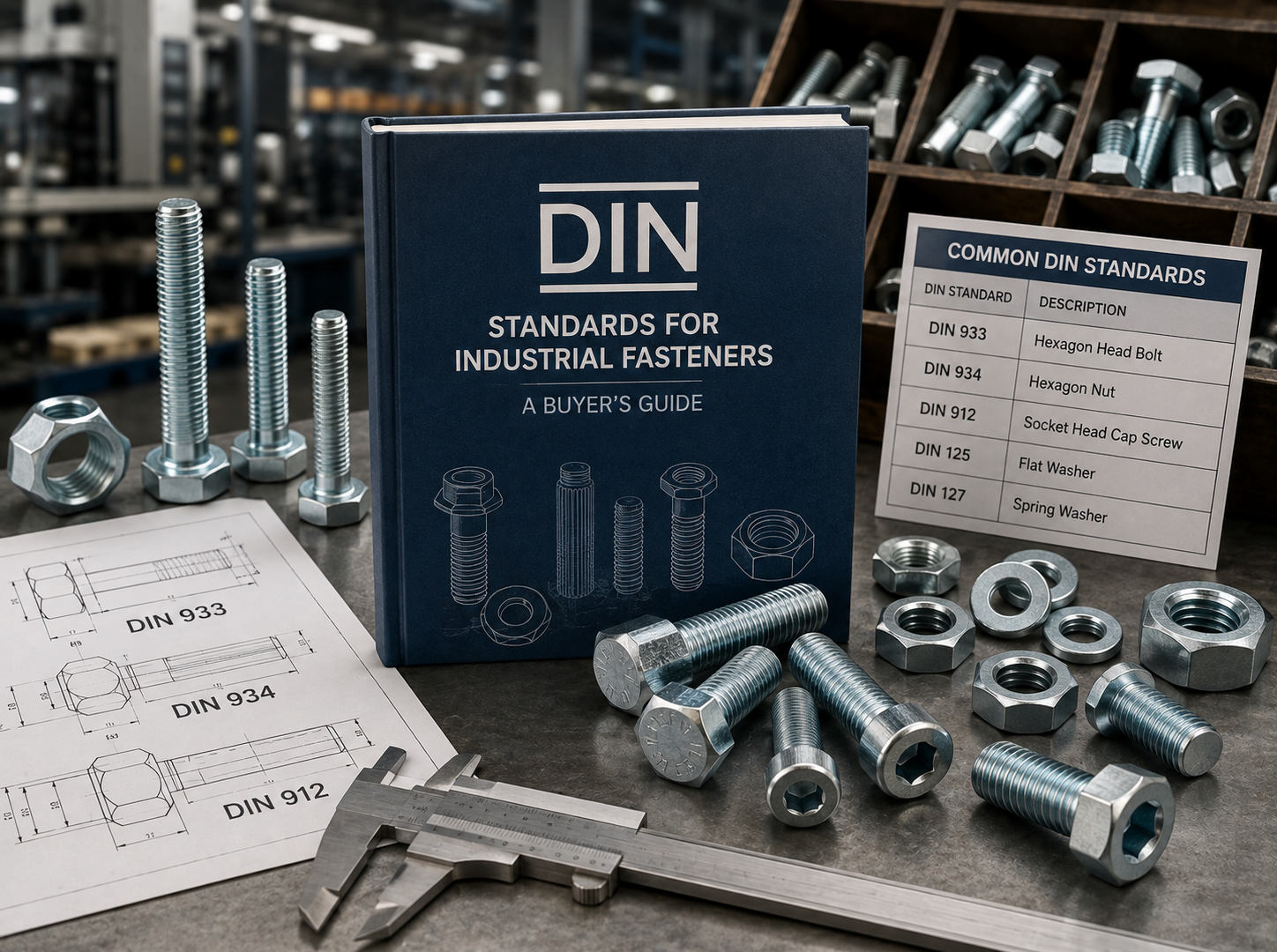
Ask any procurement engineer what slows down a fastener order the most, and the answer is rarely price. It’s specification confusion — a purchase order that says “M16 bolt, DIN standard” without saying which DIN standard, leaving the supplier to guess whether the buyer wants a fully threaded DIN 933 or a half-threaded DIN 931, and whether the mating nut should be a plain DIN 934 or a nylon-insert DIN 985.
DIN (Deutsches Institut für Normung) standards exist precisely to remove that guesswork. Each number defines a fastener’s dimensions, thread geometry, and tolerances precisely enough that a bolt made in Ludhiana and a nut made anywhere else in the world will thread together correctly, every time. For buyers sourcing internationally, knowing how to read these standards is the difference between a shipment that fits and one that gets rejected at the site.
The DIN numbers that matter most
Most structural and general-engineering fastener orders fall into a small handful of standards:
- DIN 933 — hex bolt, fully threaded along the entire shank. The default choice when the full length needs to grip.
- DIN 931 — hex bolt, partially threaded. Used where an unthreaded shank section needs to bear load in shear rather than the threads.
- DIN 934 — the standard hex nut, and the usual pairing for both of the above.
- DIN 985 — nylon-insert lock nut (what most engineers just call a “nylock”), specified wherever vibration could back a plain nut off over time.
- DIN 6923 / DIN 6921 — flange nut and flange bolt, where the integrated washer face is needed to spread load without a separate washer.
- DIN 125 / DIN 127 — flat washer and spring (lock) washer respectively.
What a DIN number actually guarantees
A DIN callout is really three separate promises rolled into one line item: the thread pitch and major/minor diameters will match ISO metric thread geometry; the across-flats and across-corners dimensions of the head or nut will match a published table, so standard tooling fits; and the material property class — 4.6, 8.8, 10.9 and so on — will meet defined tensile and yield strength minimums when tested.
That third point is where a lot of buyers get caught out. Two bolts can look identical and share a DIN number, but if one is Grade 4.6 and the other Grade 8.8, they are not interchangeable in a load-bearing application. Always confirm the property class alongside the DIN number, and ask for the mill test certificate that proves it — DIN specifies the geometry; the grade markings and accompanying documentation specify the strength.
A practical checklist before you place an order
- Specify the exact DIN number, not just “DIN standard” — 933 and 931 are not interchangeable.
- Confirm the property class (4.6 / 8.8 / 10.9) required for the application’s load.
- State the finish — plain, zinc-plated, hot-dip galvanized, or a specialty coating like Geomet — since this affects both corrosion resistance and effective thread tolerance.
- Ask whether the size is metric or one of the imperial/UNC-UNF equivalents your project may also be using.
- Request an EN 10204 3.1 mill test certificate for anything going into a structural or safety-critical assembly.
We manufacture our nut, bolt, and washer ranges to these standards as a matter of course, with dimensional tables and grade options published against each product. If you’re specifying for an export shipment or an EPC project and want the DIN number cross-checked against the right product, our team can confirm it before the order is placed rather than after the container has already left the port.