Why Mill Test Certificates (EN 10204 3.1) Matter for Export Orders
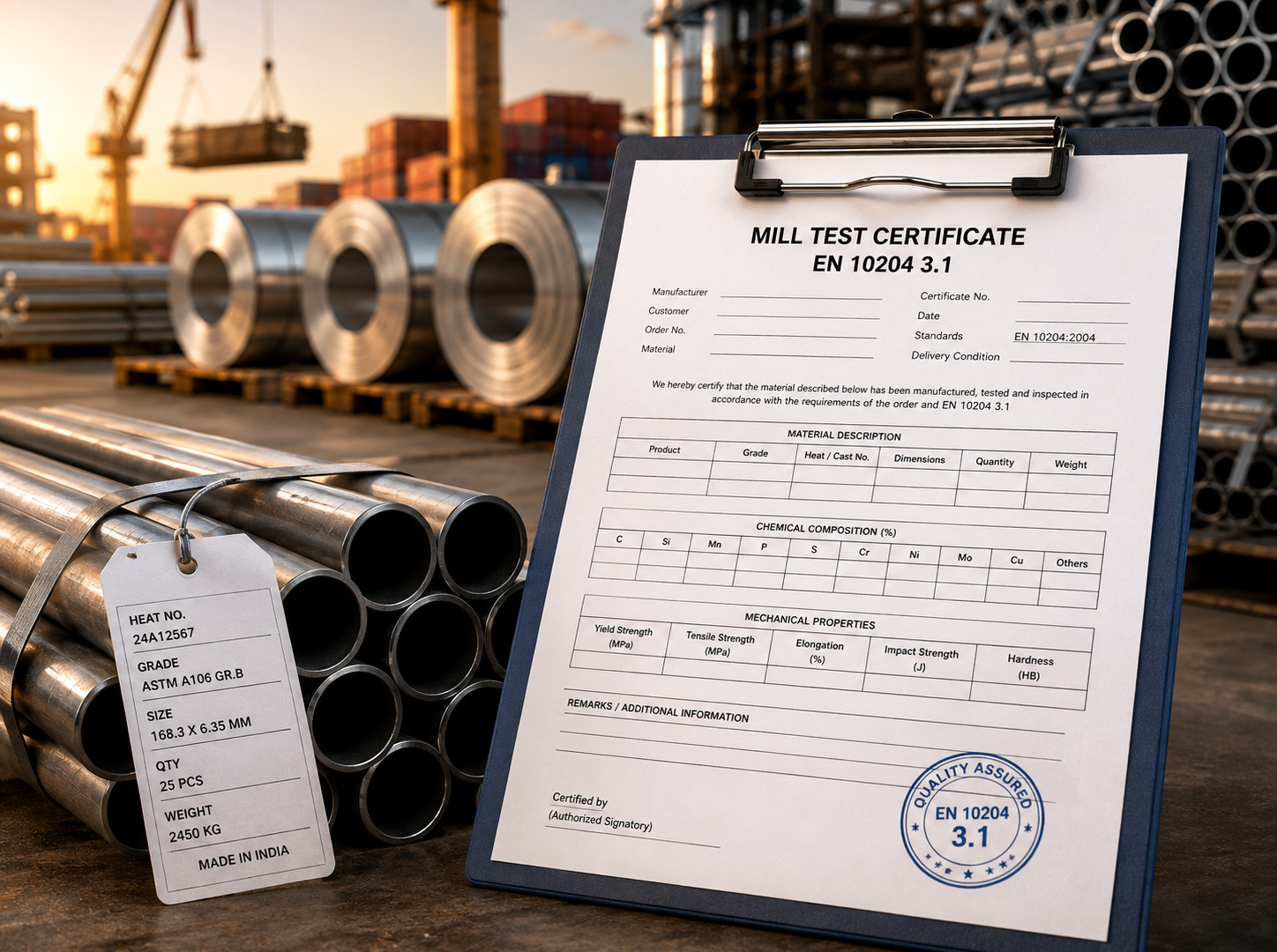
An EN 10204 3.1 certificate is one page of paper that travels with a shipment of fasteners — and for export orders, it’s often the single document that decides whether that shipment clears customs, passes a client’s incoming inspection, or gets flagged and held. Understanding what it actually certifies, and why it matters more for exports than domestic supply, is worth five minutes for anyone buying fasteners internationally.
What EN 10204 3.1 actually is
EN 10204 is a European standard that defines different levels of inspection document for metallic products. Type 3.1 is the level most structural and engineering buyers ask for: it’s issued by the manufacturer, validated by a party independent of the production department (typically the manufacturer’s own quality department, organisationally separate from the production line), and it confirms that the product supplied meets the order requirements — with actual test results, not just a statement of conformity.
In practice, a 3.1 certificate for a batch of fasteners will typically show the heat/batch number (linking the document to a specific, traceable production run), the chemical composition of the steel, and the mechanical test results — tensile strength, yield strength, elongation, hardness — measured against the grade’s specified minimums. It is not a generic “quality assured” letter; it is data, tied to a specific batch, that a buyer or inspector can independently verify against the standard.
Why this matters more for export than domestic orders
Within a single country, a lot of quality assurance happens through relationship and reputation — a buyer who has worked with a mill for years may not ask for full documentation on every order. Export changes that dynamic in three ways. First, customs authorities in many destination markets require material certification to clear specific tariff codes, particularly for structural steel products. Second, the buyer usually has no direct relationship with the mill and no way to verify quality except through documentation. Third, and increasingly, environmental and compliance regulations — REACH for restricted substances in coatings, CBAM for embedded carbon emissions on certain steel imports into the EU — require their own supporting data, which a mill test certificate and its surrounding documentation package should be able to provide or reference.
What to check on a certificate before you accept it
- Batch/heat number match — the number on the certificate should match markings or documentation on the actual physical shipment, not just be a generic attachment.
- Test values, not just pass/fail — a proper 3.1 certificate states the measured values (e.g. “tensile strength: 850 N/mm²”) against the specification’s minimum, not simply “meets DIN 933” with no numbers.
- Grade and standard consistency — the property class and dimensional standard on the certificate should match what was ordered and what’s stamped on the product.
- Issuing party — confirm it’s from the manufacturer’s quality function, independent of the production line, as EN 10204 3.1 requires.
Documentation beyond the mill certificate
For export shipments specifically, a complete documentation package usually extends beyond the 3.1 certificate itself: coating composition details sufficient to demonstrate REACH compliance where restricted substances (like certain hexavalent chromium compounds in older passivation processes) are a concern, and — for shipments into markets applying carbon border adjustments — supporting data on the production process’s emissions profile. None of this replaces the mill certificate; it sits alongside it as part of what a customs broker or compliance team will ask to see.
We issue EN 10204 3.1 mill test certificates as standard with export orders, with full batch traceability back through our own production records, and can provide the REACH and CBAM-supporting documentation our international customers’ compliance teams typically request. If you’re placing an export order and want to know exactly what paperwork will travel with it before you commit, that’s a conversation worth having at the quotation stage, not after the container has shipped.